Investing – XRP was trading at $0.48250 by 04:11 (22:41 GMT) on the Investing.com Index on Saturday, down 13.91% on the day. It was the largest one-day percentage loss since Saturday, February 20, 2021.
The move downwards pushed XRP’s market cap down to $23.18776B, or 1.36% of the total cryptocurrency market cap. At its highest, XRP’s market cap was $31.58403B.
XRP had traded in a range of $0.48250 to $0.58113 in the previous twenty-four hours.
Over the past seven days, XRP has seen a drop in value, as it lost 15.82%. The volume of XRP traded in the twenty-four hours to time of writing was $7.19729B or 4.00% of the total volume of all cryptocurrencies. It has traded in a range of $0.4825 to $0.6379 in the past 7 days.
At its current price, XRP is still down 85.33% from its all-time high of $3.29 set on Thursday, January 4, 2018.
Elsewhere in cryptocurrency trading Bitcoin , was last at $54,900.0 on the Investing.com Index, down 0.20% on the day.
Ethereum was trading at $1,865.27 on the Investing.com Index, a loss of 3.21%.
Bitcoin’s market cap was last at $1,040.64854B or 61.19% of the total cryptocurrency market cap, while Ethereum’s market cap totaled $220.30344B or 12.95% of the total cryptocurrency market value.
The first image sent by NASA’s Perseverance rover upon touching down on Mars shows its shadow upon the Red Planet’s surface, at the Jezero crater.
The rover will begin its search for traces of ancient microbial life on Mars
NASA’s science rover Perseverance, the most advanced astrobiology laboratory ever sent to another world, streaked through the Martian atmosphere on Thursday and landed safely on the floor of a vast crater, its first stop on a search for traces of ancient microbial life on the Red Planet.
Mission managers at NASA’s Jet Propulsion Laboratory near Los Angeles burst into applause and cheers as radio signals confirmed that the six-wheeled rover had survived its perilous descent and arrived within its target zone inside Jezero Crater, site of a long-vanished Martian lake bed.
The robotic vehicle sailed through space for nearly seven months, covering 293 million miles (472 million km) before piercing the Martian atmosphere at 12,000 miles per hour (19,000 km per hour) to begin its approach to touchdown on the planet’s surface.
The spacecraft’s self-guided descent and landing during a complex series of maneuvers that NASA dubbed “the seven minutes of terror” stands as the most elaborate and challenging feat in the annals of robotic spaceflight.
“It really is the beginning of a new era,” NASA’s associate administrator for science, Thomas Zurbuchen, said earlier in the day during NASA’s webcast of the event.
The landing represented the riskiest part of two-year, $2.7 billion endeavor whose primary aim is to search for possible fossilized signs of microbes that may have flourished on Mars some 3 billion years ago, when the fourth planet from the sun was warmer, wetter and potentially hospitable to life.
Scientists hope to find biosignatures embedded in samples of ancient sediments that Perseverance is designed to extract from Martian rock for future analysis back on Earth – the first such specimens ever collected by humankind from another planet.
Two subsequent Mars missions are planned to retrieve the samples and return them to NASA in the next decade.
Thursday’s landing came as a triumph for a pandemic-weary United States in the grips of economic dislocation caused by the COVID-19 public health crisis.
Search for ancient life NASA scientists have described Perseverance as the most ambitious of nearly 20 U.S. missions to Mars dating back to the Mariner spacecraft’s 1965 fly-by.
Larger and packed with more instruments than the four Mars rovers preceding it, Perseverance is set to build on previous findings that liquid water once flowed on the Martian surface and that carbon and other minerals altered by water and considered precurors to the evolution of life were present.
Perseverance’s payload also includes demonstration projects that could help pave the way for eventual human exploration of Mars, including a device to convert the carbon dioxide in the Martian atmosphere into pure oxygen.
The box-shaped tool, the first built to extract a natural resource of direct use to humans from an extraterrestrial environment, could prove invaluable for future human life support on Mars and for producing rocket propellant to fly astronauts home.
Another experimental prototype carried by Perseverance is a miniature helicopter designed to test the first powered, controlled flight of an aircraft on another planet. If successful, the 4-pound (1.8-kg) helicopter could lead to low-altitude aerial surveillance of distant worlds, officials said.
The daredevil nature of the rover’s descent to the Martian surface, at a site that NASA described as both tantalizing to scientists and especially hazardous for landing, was a momentous achievement in itself.
The multi-stage spacecraft carrying the rover soared into the top of Martian atmosphere at nearly 16 times the speed of sound on Earth, angled to produce aerodynamic lift while jet thrusters adjusted its trajectory.
A jarring, supersonic parachute inflation further slowed the descent, giving way to deployment of a rocket-powered “sky crane” vehicle that flew to a safe landing spot, lowered the rover on tethers, then flew off to crash a safe distance away.
Perseverance’s immediate predecessor, the rover Curiosity, landed in 2012 and remains in operation, as does the stationary lander InSight, which arrived in 2018 to study the deep interior of Mars.
Last week, separate probes launched by the United Arab Emirates and China reached Martian orbit. NASA has three Mars satellites still in orbit, along with two from the European Space Agency.
Shares of Motherson Sumi Systems (down 3.15 per cent), Balkrishna Industries (down 2.74 per cent), Mahindra & Mahindra (down 2.13 per cent), Hero MotoCorp (down 2.09 per cent) and Ashok Leyland (down 2.0 per cent) were the top losers in the index.
While Exide Industries (up 0.29 per cent), Bosch (up 0.08 per cent) and Maruti Suzuki (up 0.02 per cent) were among the top gainers. The Nifty Auto index was trading 1.31 per cent down at 10831.15 around 01:55PM.
Benchmark NSE Nifty50 index was down 112.20 points at 15096.7, while the BSE Sensex was down 449.93 points at 51253.9.
Among the 50 stocks in the Nifty index, 22 were trading in the green, while 28 were in the red. Shares of PNB, Bank of Baroda, Vodafone Idea, YES Bank and Central Bank Ind were among the most traded shares on the NSE.
Shares of Central Bank of India, The New India Assurance, IOB, Bank of Baroda and Union Bank India hit their fresh 52 week high in today’s trade, while Vera Synthetic Ltd., Jiya Eco Products Ltd., Sanwaria Consumer Ltd., Radha Madhav Corporation Ltd., Osia Hyper Retail Ltd. and Marine Electricals (India) Ltd. hit fresh 52 week low in trade. Posted by Technical Mechzone
Gold broke the exact line at 1815.65 and traded to lows at 1783.31 and the next target is located at 1728.91. As written many months ago, DXY, Gold and the S&P’s together traded above 5 year averages. Gold and DXY as not only complementary financial instruments that must by no other choice trade together in the same location by market order but both are non risk assets and traded against the risk asset of the S&P’s.
DXY eventually broke its 5 year average and traded to 89.22 lows, S&P’s traded higher and Gold became the mis placed financial instrument. DXY below the 5 year average at 95.00’s and Gold above at 1461.20 informs Gold remains misplaced.
Either Gold breaks below 1461.20 and joins DXY in its rightful position in the proper market order or DXY breaks above its 5 year average at 95.00 and the S&P’s trades below its 5 year at 2722.43. Its customary for DXY, Gold and the S&P’s to share negative correlations and nearly impossible for a positive correlational relationship unless the relationship of off kilter.
Silver also trades above its 5 year average at 17.74 and misaligned to DXY and the S&P’s. Silver’s first break is located at 21.72 then 19.36 and 19.06. Silver’s best move to target 17.00’s is located on the break below 19.06. The first target is established at 26.43. Not much to report to Silver as its price is a dead issue and not worth the trouble. EUR/GBP and NZD/USD not only moves far and wide but both earn more profits and quicker than a Silver trade.
The S&P’s long 3915.15 to its first target at 3924.99 achieved its destination however lows traded to 3918.52. Not much existed to the S&P trade overall nor was much expected particularly after a Monday holiday and no change to daily interest rates.
S&P and DAX trades Today’s S&P’s for a quick trade is long 3912.92 to target 3922.75 then 3927.66.
Today’s DAX for anothe quick day trade is long 13994.27 to target 14029.43 then 14054.60.
EUR/USD Yesterday’s EUR/USD dropped exactly at the confluence of the daily and weekly entry at 1.2168 and target at 1.2065 achieved however lows traded to 1.2063 for an extra 2 pips.
EUR/USD For the 2ng leg to the weekly trade as posted Sunday, EUR/USD is in a crucial position and quite the opposite to the ease of the first trade yesterday. EUR/USD’s significant high/low point is located at 1.2040 and a break lower then much room exists for a drop to 1.1947.
Today’s longs are located at 1.2065 for the weekly target at 1.2114 and the daytrade location is 1.2117.
To add a 3rd leg due because our trades are continuous and never end, short at 1.2114 and 1.2117 targets 1.2094 and 1.2090. EUR/USD low point today is located at 1.2033 and 1.2026 and the daily target on a break of 1.2040.
प्लूटो एक बौना ग्रह है जिसकी खोज 1930 में क्लाइड टॉमबो नाम के वैज्ञानिक ने की थी। यह बौना ग्रह भी अन्य ग्रहों की तरह ही सूर्य की परिक्रमा करता है। लेकिन यह आकार में बहुत छोटा है। इसकी खोज आज ही के दिन यानी 18 फरवरी को हुई थी।
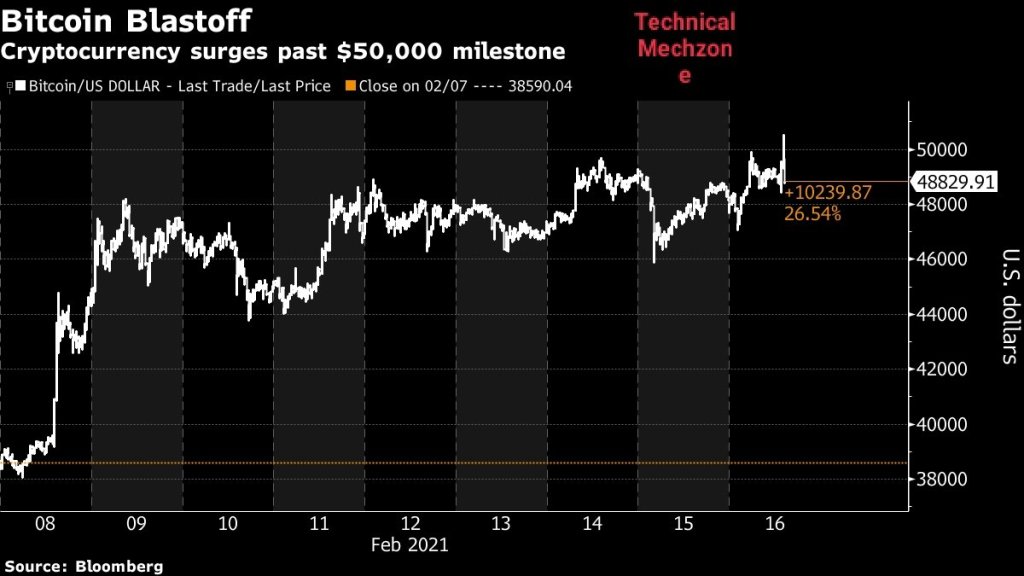
Bitcoin blew through another milestone, surging past $50,000 for the first time as the blistering rally in the largest cryptocurrency continues to captivate investors worldwide.
The world’s largest cryptocurrency jumped as much as 4.9% to $50,548 and is now up about 70% so far this year. Bitcoin pared its gain after setting the record high. Ether, a rival crypto, hit a record on Friday and is up about 140% year-to-date.
After ending last year with a fourth-quarter surge of 170% to around $29,000, Bitcoin token jumped to $40,000 seven days later. It took just nearly six weeks to breach the latest threshold, buoyed by endorsements from the likes of Paul Tudor Jones, Stan Druckenmiller and Elon Musk. Bitcoin traded for a few cents for several years after its debut more than a decade ago
Tesla Inc.’s announcement that it added $1.5 billion in Bitcoin to its balance sheet was the most visible recent catalyst, sending the price up 16% on Feb. 8, the biggest one-day gain since the Covid-19 inspired financial markets volatility in March. Optimism grew after Mastercard Inc. and Bank of New York Mellon Corp. moved to make it easier for customers to use cryptocurrencies, while Bloomberg reported Saturday that Morgan Stanley may add Bitcoin to its list of possible bets.
“Whether it’s Musk, Mastercard or Morgan Stanley, the mood, music and momentum is impossible to ignore,” said Antoni Trenchev, managing partner and co-founder of Nexo in London, one of the biggest crypto lenders. “To the annoyance of many, the Bitcoin express has left the station.”
Tesla Boots the Bitcoin Bandwagon Closer to Corporate America
MicroStrategy Inc. doubled down on its big bet on Bitcoin. The enterprise software maker said Tuesday that it would sell $600 million of convertible bond, with the intention of adding to its Bitcoin stash. This is the second time in three months that the Tysons Corner, Virginia-based company issued debt to fund the purchase of Bitcoin.
The 400% rally over the past year comes amid a backdrop of near zero borrowing rates from central banks and unprecedented stimulus from governments in the wake of the coronavirus pandemic. Bitcoin advocates have criticized the moves as money printing even though inflation remains subdued.
Mastercard, in a blog post last week, singled out so-called “stablecoins,” which often peg their value to that of another asset, such as the U.S. dollar. Mastercard has already partnered with crypto card providers such as Wirex and BitPay, but has required digital currencies to be converted into fiat before processing payments for transactions on its network.
Trenchev cautioned that investors should be prepared for a wild ride after the latest milestone, pointing to last month’s 30% pullback as evidence.
“Short-term volatility is very much a feature of this bull market and investors should prepare accordingly,”
(A Bohemian idea that defies state control can easily gain popularity but cannot escape regulation)
If India were a parent, what kind would it be? I think it would like to accompany you on your honeymoon. So it was a bit surprising that India tolerated the Bohemian idea of cryptocurrencies for so long. But now the government plans to introduce a new piece of legislation that will outlaw Bitcoin and other cryptocurrencies. India also plans to introduce its own digital currency, thus making crypto uncool. In fact, it would not be a cryptocurrency if a government issues it.
It is not only India, governments across the world have started banning them. The cryptoprophets expected this, but they underestimated the power of the state. That the state is an actualization of an ethical idea might be a lie, but a successful myth. And old successful lies are hard to dislodge. Since 2009, when Bitcoin was created, some of the brightest tech Bohemians have sold the world a lemon. That a new kind of global currency will end the monopoly of governments and central banks over money. This new currency will not exist in physical form, it will be created from nothing by a vast network of computers as they perform a vast number of computations to randomly create it. The currency will have no intrinsic value beyond the perception that it has value, and its own predetermined scarcity.
The lure of a cryptocurrency is that it can make transactions between two individuals secure and possible without inefficient intermediaries like banks and rule-makers like governments. It offers complete anonymity and freedom—two things that governments, including democratic ones, dislike. In fact, governments dislike even their own currency notes, as it provides anonymity and too much freedom.
So, why did some people think governments would allow cryptocurrencies to thrive, or even survive? Why would governments permit a system that could end its own relevance ?
But then, who would have thought in the golden days of monarchy that all of the affluent world and most of the poor world, too, will come under the spell of a laughable idea called democracy where ordinary people elect who wields power over them?
Cryptocurrency is only a type of extreme financial and emotional democracy. Even so, it is doomed in its present form. Its technology platforms, like blockchain, will become standard as governments themselves adopt them, but the cryptocurrency as we know it today will stand no chance against fiat.
Fiat currency is based on trust in the authority that issues it. Bitcoin, on the other hand, is built on a fascinating misanthropic question: Given that two humans cannot and should not be trusted, how can a network of computers confirm that a transaction is fair?
The way people are drawn to anonymity, you would think they do something very interesting and naughty every day, and the way they react to security, you would think some transaction vanishes from their digital ledgers every day. In reality, most people are mostly dull. Yet, there is no doubt the world is in the grip of a Bitcoin mania. And it is entirely a creation of extraordinary storytelling. It has a hero who is mysterious, brilliant, moral, austere and philosophical.
His name is certainly not Satoshi Nakamoto. In the aftermath of the financial crisis of 2008, a person who went by that name created, completed or revealed an elaborate computer programme that cryptographers say is an exquisite piece of work, and he also wrote a series of essays laying out the moral reason for a new kind of money—governments and central banks were corrupt and unfit to regulate money. And he raised a philosophical question: Do we need the inconvenience of trust to transact? What if computers make a dishonest transaction so mathematically improbable that it is impossible, and also grants anonymity? He has since vanished, leaving us a revolutionary monetary system that is today worth nearly $1 trillion. minte-paperNew
If India were a parent, what kind would it be? I think it would like to accompany you on your honeymoon. So it was a bit surprising that India tolerated the Bohemian idea of cryptocurrencies for so long. But now the government plans to introduce a new piece of legislation that will outlaw Bitcoin and other cryptocurrencies. India also plans to introduce its own digital currency, thus making crypto uncool. In fact, it would not be a cryptocurrency if a government issues it.
It is not only India, governments across the world have started banning them. The cryptoprophets expected this, but they underestimated the power of the state. That the state is an actualization of an ethical idea might be a lie, but a successful myth. And old successful lies are hard to dislodge.
Since 2009, when Bitcoin was created, some of the brightest tech Bohemians have sold the world a lemon. That a new kind of global currency will end the monopoly of governments and central banks over money. This new currency will not exist in physical form, it will be created from nothing by a vast network of computers as they perform a vast number of computations to randomly create it. The currency will have no intrinsic value beyond the perception that it has value, and its own predetermined scarcity.
The lure of a cryptocurrency is that it can make transactions between two individuals secure and possible without inefficient intermediaries like banks and rule-makers like governments. It offers complete anonymity and freedom—two things that governments, including democratic ones, dislike. In fact, governments dislike even their own currency notes, as it provides anonymity and too much freedom.
So, why did some people think governments would allow cryptocurrencies to thrive, or even survive? Why would governments permit a system that could end its own relevance ?
But then, who would have thought in the golden days of monarchy that all of the affluent world and most of the poor world, too, will come under the spell of a laughable idea called democracy where ordinary people elect who wields power over them?
Cryptocurrency is only a type of extreme financial and emotional democracy. Even so, it is doomed in its present form. Its technology platforms, like blockchain, will become standard as governments themselves adopt them, but the cryptocurrency as we know it today will stand no chance against fiat.
Fiat currency is based on trust in the authority that issues it. Bitcoin, on the other hand, is built on a fascinating misanthropic question: Given that two humans cannot and should not be trusted, how can a network of computers confirm that a transaction is fair?
The way people are drawn to anonymity, you would think they do something very interesting and naughty every day, and the way they react to security, you would think some transaction vanishes from their digital ledgers every day. In reality, most people are mostly dull. Yet, there is no doubt the world is in the grip of a Bitcoin mania. And it is entirely a creation of extraordinary storytelling. It has a hero who is mysterious, brilliant, moral, austere and philosophical.
His name is certainly not Satoshi Nakamoto. In the aftermath of the financial crisis of 2008, a person who went by that name created, completed or revealed an elaborate computer programme that cryptographers say is an exquisite piece of work, and he also wrote a series of essays laying out the moral reason for a new kind of money—governments and central banks were corrupt and unfit to regulate money. And he raised a philosophical question: Do we need the inconvenience of trust to transact? What if computers make a dishonest transaction so mathematically improbable that it is impossible, and also grants anonymity? He has since vanished, leaving us a revolutionary monetary system that is today worth nearly $1 trillion.
Nakamoto showed that absolute anonymity was possible and not always shady. He even made it look sacrificial in a world desperate for fame.
Some people believe he is too good to be a single person; that he is probably a group of people. What if Nakamoto is the Central Intelligence Agency (CIA)? Or something like that? After all, the National Security Agency of the US did ponder the idea of cryptocurrency in an academic paper years before Nakamoto published his essay on it.
If I were the CIA, I would create a Bohemian cryptocurrency for every anarchist to adopt, and quietly and sit and watch what they are up to. I am not suggesting Nakamoto is a government agent, but the fact that the creator of cryptocurrency is not known defeats the very freedom Bitcoin stands for. This is why the government always wins. It has a face, however ugly. And the face reassures a majority.
History is filled with wild things that were supposed to be free, but eventually got regulated by governments. The internet itself was supposed to diminish government control, as no single power can destroy it. Yet, every government has the power today to regulate it. Social media, too, was expected to transform the world, especially through photogenic rebels on Twitter and Facebook. But these platforms are now begging governments to let them be. Streaming channels were suppose to force conservative societies to accept the freedom of artistic expression, but, as evident in India, they have meekly agreed to censor themselves to massage the thin skin of a majority.
Cryptocurrencies, too, will fail. You may argue that they’ll survive in a less rebellious form. But then a crypto has a binary quality. Either it is entirely free of state control, or it’s just another fiat currency in digital form.
The world’s largest cryptocurrency reached about $49,344 earlier in the day, and was around $49,202 as of 10:20 am in London. It’s now up about 70% so far this year. Rival cryptocurrency Ether hit a record on Saturday and is up about 150% year-to-date.
Bitcoin has been buoyed in recent months by endorsements from the likes of Paul Tudor Jones and Stan Druckenmiller. Bloomberg reported earlier that Morgan Stanley may bet on Bitcoin in its $150 billion investment arm, following news late last week that BNY Mellon plans to service cryptocurrencies for its clients. And that’s after Tesla Inc. put about $1.5 billion into Bitcoin. Skeptics warn the asset class could be in a bubble, however.
“With each major announcement like the one BNY Mellon made, other institutions are spurred to more rapid adoption and deployment of digital assets,” said Patrick Campos, chief strategy officer at Securrency, a developer of blockchain-based financial and regulatory technology, on Friday. “Tesla’s recent announcement will embolden other large corporates and institutions to accept crypto as not just a worthy asset class, but perhaps even an essential one. More important, is the corresponding build-out of institutional services to support these developments will trigger other digital assets-related developments within those institutions and in the larger ecosystem.”
India will go ahead with a complete ban on investment in cryptocurrencies, while providing existing investors a transition period to exit their holdings.
Cryptocurrency isn’t fiat currency backed by the Reserve Bank of India and its usage in all forms will be banned through the new law that will be introduced in Parliament.
This would include a ban on transacting directly via foreign exchanges.
Seven million investors hold cryptocurrencies in India worth more than one billion dollars. The ban won’t be enforced overnight and cryptocurrency investors will be given a transition period of three-to-six months after the implementation of the new law to liquidate their investments. The proposed ban — is part of a comprehensive bill on crypto and digital currencies. It may be introduced in the ongoing budget session of parliament.
Does this mean the end of the road for cryptocurrencies in India?
Not really, the bill may include certain exceptions. They could allow the promotion of the underlying technology. Like block chain, the decentralized digital ledger.
That drives — all types of cryptocurrencies.
An exception like this could provide the legal framework for the reserve bank of India to launch its official digital currency. China has a similar regulatory regime. It effectively banned trading and usage of cryptocurrencies in 2017.
Crypto exchanges were shut down. Last year; Beijing began testing its own digital currency in four cities. India’s move to regulate digital cash comes at a time — when the world is increasingly adopting it.
MasterCard and Visa have opened their payments network for some cryptocurrencies.
Customers using these platforms can now pay or accept money through crypto. Recently, auto giant Tesla made a big bet on bitcoin.
The company bought more 1.5 billion dollars worth of bitcoin.
It also allowed customers to pay through bitcoin for its products. Cryptocurrencies are now part of the mainstream global financial system.
India cannot afford to ignore this shift but it needs a legal framework first.
People, traders, exchanges, and other financial systems’ participants will not be permitted to deal in cryptocurrencies with penalties proposed in the draft law for any violation by corporates as well as individuals
The Cryptocurrency and Regulation of Official Digital Currency Bill, 2021 is expected to be introduced soon in the ongoing Budget session (of parliament).
People, traders, exchanges, and other financial systems’ participants will not be permitted to deal in cryptocurrencies, with penalties proposed in the draft law for any violation by corporates as well as individuals, NDTV reported. The decision was taken after an inter-ministerial panel, including representatives from the Reserve Bank of India (RBI), felt that private cryptocurrencies will pose a risk to the financial stability of the country.
The bill, which proposes a blanket ban on all private cryptocurrencies, will also lay the basis for an official digital currency with ties to the RBI, which can regulate it, the report added.
The Centre’s draft bill comes days after car manufacturer Tesla, led by billionaire Elon Musk, announced a $1.5 billion investment in Bitcoin with plans to accept the cryptocurrency from customers purchasing its electric vehicles. This drove the digital money to an all-time high. Both the Centre and the central bank have been cautioning against digital currencies and have advised all banks and financial institutions not to deal in them. The RBI, through a circular in April 2018, had advised all entities regulated by it not to deal in virtual currencies or provide services for facilitating any person or entity in dealing with or settling them.
In mid-2019, a government committee had suggested banning all private cryptocurrencies, with a jail term of up to 10 years as well as heavy penalties for anyone dealing in digital currencies.
However, the Supreme Court in March 2020 overturned RBI’s circular, permitting banks to handle cryptocurrency transactions from traders and exchanges.
As per the official estimates, around 7 million Indians hold cryptocurrencies worth more than $1 billion.










 Technical mechzone