Introduction: Bitcoin, the first decentralized cryptocurrency, has transformed the way we think about money. Launched in 2009 by an anonymous figure known as Satoshi Nakamoto, Bitcoin has grown into a global phenomenon. With its unique features and underlying technology—blockchain—Bitcoin has reshaped the financial landscape and sparked the creation of thousands of other cryptocurrencies. In this post, we’ll dive into a detailed review of Bitcoin and its impact on the world.
What is Bitcoin? Bitcoin is a digital currency, also known as a cryptocurrency, that operates on a peer-to-peer network. Unlike traditional currencies, Bitcoin isn’t issued or controlled by any government or central bank. Instead, it’s managed through a decentralized network of computers that validate transactions via blockchain technology.
How Does Bitcoin Work? Bitcoin transactions are secured and verified through cryptography. When someone sends Bitcoin to another user, the transaction is recorded in a public ledger known as the **blockchain**. The blockchain is decentralized, meaning it is not controlled by any one entity, ensuring transparency and security. Transactions are verified by miners, who use computational power to solve complex mathematical puzzles. In return for their efforts, miners are rewarded with newly minted Bitcoins.
Advantages of Bitcoin: Decentralization: Bitcoin operates without a central authority, making it immune to government interference. Security: The use of blockchain and cryptography makes Bitcoin transactions highly secure. Limited Supply: Bitcoin has a fixed supply of 21 million coins, making it immune to inflation. Global Transactions: Bitcoin allows for fast and low-cost international transactions without the need for intermediaries like banks.
Challenges of Bitcoin: **Price Volatility:** Bitcoin’s value can fluctuate dramatically, making it risky for investors. **Regulatory Uncertainty:** Governments around the world are still figuring out how to regulate cryptocurrencies. **Scalability Issues:** Bitcoin’s transaction speed and network capacity are limited, causing delays and higher fees during periods of high demand.
Bitcoin’s Impact on the Financial World: Bitcoin has paved the way for decentralized finance (DeFi) and has inspired the creation of many other cryptocurrencies. It challenges traditional financial systems by offering an alternative to centralized banking. Bitcoin is also being adopted by businesses for payments, and some even consider it a “store of value” akin to gold.
Conclusion: Bitcoin is a revolutionary financial asset with the potential to disrupt traditional systems. While it offers many benefits, such as decentralization and security, it also faces challenges like volatility and scalability issues. As Bitcoin continues to evolve, its influence on global finance will only grow, with its impact already being felt worldwide.
There are several trading platforms available, and the best one for you will depend on your specific needs and preferences. Here are some popular trading platforms:
eToro: Known for its social trading features, eToro allows users to follow and copy the trades of successful traders. It offers a wide range of assets and a user-friendly interface.
TD Ameritrade: A well-established platform in the United States, TD Ameritrade provides a comprehensive trading experience with a variety of investment options, educational resources, and advanced trading tools.
Interactive Brokers: This platform is popular among active traders due to its low-cost trades and extensive range of investment options, including stocks, options, futures, and more. It offers powerful trading tools and research capabilities.
Robinhood: Robinhood gained popularity for its commission-free trading model and user-friendly mobile app. It primarily focuses on stock trading and offers a simplified trading experience.
Fidelity: Fidelity is a reputable brokerage firm that provides a wide range of investment products, including stocks, ETFs, mutual funds, and more. It offers a user-friendly platform with robust research and educational resources.
Charles Schwab: Known for its strong customer service and comprehensive investment offerings, Charles Schwab provides access to stocks, bonds, ETFs, options, and more. It offers intuitive trading platforms and a wide range of educational materials.
Coinbase: If you are interested in cryptocurrency trading, Coinbase is a well-known platform that allows you to buy, sell, and store various cryptocurrencies. It offers a user-friendly interface and a high level of security.
It’s important to conduct thorough research and consider factors such as fees, available assets, trading tools, security measures, and customer support when selecting a trading platform. Additionally, regulations and availability may vary depending on your country of residence.
Walking early in the morning can have numerous benefits for your physical and mental well-being. Here are some advantages of walking in the morning:
1.Fresh air and peaceful environment: Early mornings often offer cleaner air and less noise pollution compared to later in the day. Taking a walk during this time allows you to breathe in fresh air and enjoy a peaceful environment, which can be refreshing and invigorating.
2.Boosts energy: Walking in the morning can help wake you up and provide an energy boost for the day ahead. It increases blood circulation, oxygenates your body, and activates your muscles, leading to improved alertness and productivity.
3.Enhances mood and mental clarity: Walking releases endorphins, which are natural mood-boosting hormones. Starting your day with a brisk walk can help reduce stress, anxiety, and depression while improving mental clarity and focus.
4.Weight management: Walking is a low-impact exercise that can aid in weight management. By engaging in a morning walk, you kickstart your metabolism, burn calories, and set a positive tone for the rest of the day in terms of making healthier choices.
5.Improved cardiovascular health: Regular walking can help strengthen your heart, lower blood pressure, and reduce the risk of cardiovascular diseases. By incorporating a morning walk into your routine, you can improve your overall cardiovascular health.
5.Better sleep: Morning walks can help regulate your body’s internal clock and improve sleep patterns. Exposure to natural light early in the day helps regulate your circadian rhythm, making it easier to fall asleep and wake up at the desired times.
6.Increased creativity: Walking has been shown to stimulate creativity and enhance cognitive function. By taking a walk in the morning, you can start your day with a fresh perspective, allowing your mind to wander and generate new ideas.
Remember to wear comfortable shoes, stay hydrated, and consider your physical limitations or any medical conditions before engaging in any exercise routine.
Starting your own business can be an exciting and rewarding venture. Here are some steps to help you get started:
1.Define Your Business Idea: Identify your passion, interests, and skills. Determine what products or services you want to offer and assess their market demand and viability. Conduct market research to understand your target audience, competitors, and industry trends.
2.Create a Business Plan: Outline your business goals, strategies, and financial projections in a comprehensive business plan. It will serve as a roadmap for your venture and help you secure funding, if needed. Include sections such as executive summary, company description, market analysis, organization and management structure, product/service line, marketing and sales strategy, and financial projections.
3.Secure Funding: Assess your financial needs and explore different options to fund your business. This could include personal savings, loans from banks or credit unions, investments from family and friends, or seeking venture capital. Consider creating a budget to estimate your startup and operational costs.
4.Choose a Legal Structure: Decide on the legal structure that suits your business, such as a sole proprietorship, partnership, limited liability company (LLC), or corporation. Research the legal and tax implications of each structure and consult with a lawyer or accountant to make an informed decision.
5.Register Your Business: Choose a unique business name and register it with the appropriate government authorities. Obtain the necessary permits, licenses, and certifications required to operate legally. Consider trademarking your brand name or logo to protect your intellectual property.
6.Set Up Your Operations: Determine the location for your business and set up the necessary infrastructure, such as office space, equipment, and technology. Establish your supply chain and vendor relationships, if applicable. Consider hiring employees or outsourcing tasks as needed.
7.Develop a Marketing Strategy: Identify your target audience and develop a marketing plan to reach them effectively. Build a brand identity, create a website, and establish your online presence through social media platforms. Utilize various marketing channels, such as advertising, content marketing, search engine optimization (SEO), and networking to promote your business.
8.Launch Your Business: Execute your business plan and launch your products or services. Monitor your operations closely and make adjustments as necessary. Seek customer feedback and strive for continuous improvement.
Remember, starting a business requires hard work, perseverance, and flexibility. Seek guidance from mentors, industry experts, and professional advisors to increase your chances of success.
1.Unity power, in the context of computer graphics and game development, refers to the use of the Unity game engine. Unity is a popular and powerful game development platform that allows developers to create interactive experiences, including games, simulations, and other applications, for various platforms such as desktop, mobile, and virtual reality.
2.Unity provides a range of features and tools that enable developers to design and build games with ease. It offers a visual editor that allows for intuitive scene and asset management, a scripting system using C# for programming logic, and a comprehensive set of built-in components and systems for physics, rendering, audio, animation, and more.
3.One of the strengths of Unity is its cross-platform support, which means developers can build a game once and deploy it on multiple platforms without significant code changes. This makes it a popular choice for indie developers, small studios, and larger game development companies.
4. Unity also has an active community and ecosystem, with a vast library of ready-to-use assets, plugins, and tutorials available, making it easier for developers to enhance their projects and learn from others.
Overall, Unity power refers to the capabilities and versatility of the Unity game engine in enabling developers to create high-quality, cross-platform games and interactive experiences efficiently.
Becoming a rich person is a goal that many people aspire to achieve. While there is no guaranteed formula for becoming rich, there are certain strategies and principles that can increase your chances of building wealth. Here are some steps you can take:
1. Set clear financial goals: Define your financial objectives and create a plan to achieve them. Set specific, measurable, achievable, relevant, and time-bound (SMART) goals.
2.Develop a strong work ethic: Building wealth often requires hard work and dedication. Be prepared to invest time and effort into your chosen path.
3. Pursue education and skill development: Continuously seek opportunities to enhance your knowledge and skills. Acquiring expertise in a particular field can lead to better job prospects or entrepreneurial opportunities.
4. Save and invest wisely: Develop a habit of saving money regularly and living within your means. Create a budget and stick to it. Invest your savings wisely to generate passive income and grow your wealth over time.
5. Diversify your income sources: Relying solely on one income stream can be risky. Explore multiple sources of income, such as starting a side business, investing in stocks or real estate, or generating passive income through royalties or investments.
6. Network and build relationships: Surround yourself with like-minded individuals and professionals who can provide support, mentorship, and potential business opportunities. Attend networking events, join professional organizations, and leverage social media platforms to expand your connections.
7. Take calculated risks: Successful entrepreneurs and investors often take calculated risks to grow their wealth. Educate yourself about different investment opportunities and assess the potential risks and rewards before making any decisions.
Remember, becoming rich is not solely about monetary wealth. It’s also important to pursue a well-rounded and fulfilling life that includes good health, meaningful relationships, and personal happiness.
In this post, you learn the grinding machine and grinding machine operation, types of grinding wheel and more.
Grinding Machine
Contents hide 1. Grinding Machine 2.Hardness Comparison of Abrasive Material 3.Cost of Grinding Wheel 4. Life of Grinding Wheel 5. Selection of Abrasives in Grinding 6.Silicon carbide 7. Aluminium oxide 8. Selection of Grinding Wheels 9. Bond and Types of bond 10. Vitrified Bond 11. Silicate Bond 12. Shellac Bond 13. Rubber Bond 14. Resinoid Bond 15 Wheel Grit, Grade and Structure 16. Grit 17 .Grade 18. Structure 19. Balancing, Dressing, and Truing of Grinding wheels 20 . Balancing 21. Dressing 22. Truing 23. Grinding Machine Operation 24. Surface Grinding 25. Cylindrical Grinding
A grinder is commonly used to precisely shape and finish the given materials with low surface roughness and high surface quality. Grinding machine is a type of machine used to grind the workpieces. It basically uses emery or an abrasive wheel as the cutting tool.
The grinding process is truly a chip producing machining process. The rough surface of the abrasive wheel spreads into small portions of the workpiece as required. It is also known as a grinder.
The grinding process is capable of producing very accurate sizes, equally accurate geometry like flatness or circle and extremely good surface finish. It is capable of machining hardness high-speed steel, which cannot be done by other machining processes.
Abrasives wheels are the impure form of aluminium oxide. A grinding wheel or bonded abrasive is made up of thousands of tiny abrasive particles insert in matric calls as ‘bond’.
In bonded abrasives, porosity is essential to provide clearance for the chips being produced and to provide cooling, otherwise chips would interfere with the griding process.
Hardness Comparison of Abrasive Material An abrasive is a second hardest material, compared to diamond.
Aluminium oxide (hardness of 2000-3000) Silicon carbide (hardness of 2100-3000). These are the perfect examples of conventional abrasives. The cubic boron nitrite (hardness of 4000-5000) Diamond (hardness of 7000-8000) comes under the category of super abrasives. In addition to hardness, an important characteristic called friability. Friability is the ability of abrasive grains to fracture (break) into small pieces. High friability indicates low strength or low fracture resistance of the abrasive.
For example, aluminium oxide has a lower friability than silicon carbide and has fewer tendencies to a piece. Bonded abrasive are marked with a standardization system of letters and numbers, indicating the type of abrasive, grain size, grade, structure, and bond type.
Cost of Grinding Wheel The cost of grinding wheel depends on the type of size of the wheel.
Small wheels of 25mm diameter cost up to 10$ for conventional abrasive and for diamond up to 200$. Large wheel of 500mm diameter and 250mm width, the cost is about 8000$ to 20000$. Life of Grinding Wheel When a grinding wheel is applied to the workpiece, the sharp edges of the abrasive grains which are cutting, will, in the end, lose their cutting effect and become dull.
At that stage, the abrasive grains should either split or form new edges or it should break away from the wheel exposing the next layer of grains to do work.
If the dulled grains stay in the wheel, they simply keep on rubbing on work without actually cutting. This defect is known as ‘glazing’. If on the other hand, the abrasive grains break away from the wheel or split prematurely, before becoming dull, it causes a reduction in life of the grinding wheel.
Selection of Abrasives in Grinding
Emery and corundum are no longer used in modern grinding wheels.
instead, artificially manufactured abrasives are used due to their high purity. And they include silicon carbide and aluminium oxide.
1. Silicon carbide
Silicon carbide is greenish-black in colour.
It is harder and more brittle than alumina. For this reason, it is used for grinding materials of low grinding resistance like cast iron, brass, and copper.
The code for silicon carbide is C.
2. Aluminium oxide
It is reddish-brown in colour.
Aluminium oxide abrasive is more suitable for grinding most steels because of its greater toughness to cope with increased grinding resistance offered.
Aluminium oxide wheels it is A.
The abrasive, the performance of grinding wheels also depends on many other factors. It is important that a suitable grinding wheel is selected for particular applications.
Selection of Grinding Wheels
It means choosing the most appropriate wheel for a particular grinding machine operation. Wheel selection would depend on what abrasive is required, and characteristic of the wheels and also on operating conditions like a wheel and work speed, type and conditions of machines used.
Thumb rule is to use a hard wheel for soft material and soft wheel for hard material. A hard wheel retains the abrasives as they do not get dulled easily on soft materials.
Bond and Types of bond
Bond refers to the substance of which the matrix of the grinding wheel is made. The following bonds are generally used in the manufacture of grinding wheels. The bond hardness or grade is usually represented by the letters of the English alphabet.
A represents the very soft grade, while Z is very hard M and N represent medium grade hardness.
Vitrified Bond
Silicated Bond
Shellac Bond
Rubber Bond
Resinoid Bond
1. Vitrified Bond
It is denoted by letter V.
About 80% of the wheels used in the industry are of this bond.
It is also called as ceramic bond.
They are strong, stiff, porous, and resistant to oils, acids, and water. They are brittle and lack resistance to mechanical and thermal shock.
2. Silicate Bond
It is denoted by letter S.
Silicate of soda (commonly known as water glass) is the main component of this bond.
3. Shellac Bond
It is denoted by letter E.
Shellac (a naturally available material) is the main component of the bond.
4. Rubber Bond
It is denoted by letter R.
This process consists of mixing crude rubber, sulfur, and the abrasive grains together, rolling the mixture into sheets, cutting out circles and heating them under pressure to vulcanize the rubber.
The wheels can be made like this and can be used as saws for cutting-off operations.
5. Resinoid Bond
It is denoted by letter B.
Resoniod bonding materials are thermosetting resins, and the bond is an organic compound, so the wheels with resinoid bonds are also called as organic wheels.
Some of these wheels are made from bakelite and other resinous material.
Wheel Grit, Grade and Structure
1. Grit
Grit indicates the size of the abrasive grain. It is indicated by a number. Higher the number, smaller the size of grains. Abrasives finer than 200, are called “flours” designated as F, FF, and FFF.
The finer abrasive used as jewellers. For the fine finish of ground surface,
smaller grit size abrasive wheels are used. But their metal cutting capacity is limited.
Large size abrasive wheels, finish is rough but metal removal rate is higher.
2. Grade
The degree of hardness possessed by the bond is called the grade of the wheel and indicates the strength of the grip with which the abrasive grains are held in the bond.
It indicates the type and the amount of bond in the wheel. It is also referred to as the hardness of a bonded abrasive. A hard wheel has a stronger bond and a larger amount of bonding material between the grains than a soft wheel.
3. Structure
Structure of a bonded abrasive is a measure of the porosity (spacing between the grains). The structure of the bond material in a wheel varies from about 10% to 30% of its total volume. Structure of the bond depends upon this percentage.
If the abrasive grains are too strictly packed, the percentage of bond material will be on the lower side this is called a closed structure.If the abrasive grains are less strictly packed in the same volume, the wheels are called an open structure.
The structure is indicated by a number varying from 1 (very closed structure) to 15 (very open structure. On every grinding machine wheel, the manufactures are limit to give the following information. in specified sequence about the,
Abrasive used (A or C)
Grit number (ex: 46)
Grade ( A to Z)
Structure (1 to 5)
Bond type (by letters)
In addition, the manufacturer is free to supply some additional information with the above information.
Balancing, Dressing, and Truing of Grinding wheels
1. Balancing
A grinding wheel is a fragile tool which is to be used to get perfect service. proper mounting and balancing of the wheel are very important.
Balancing is needed as wheels revolve at higher speed (many thousand r.p.m.) and any unbalanced centrifugal forces may crack the wheel or spoil and bearing.
2. Dressing
The dressing is the process of producing sharp edges on grains, conditioning worn grains on the surface of a grinding wheel. It is required when the wheel is dull or tired.
3. Truing
The Truing is like a dressing operation by which wheel comes back to its original shape, thus around the wheel is dressed to make its circumference a true circle.
Truing is done during fitting fresh wheel and also it is necessary after the wheel has been in use for some time, to correct the non-uniform wear on its face.
For softer wheels, truing and dressing are done separately and for harder wheels, both are done at the same time. The truing or dressing up of grinding wheels are normally done by a diamond tool. Being harder, it is able to cut through, the
Grinding Machine Operation
The common grinding machine operation are surface, cylindrical, internal and centreless grinding. Now let us discuss each one by one,
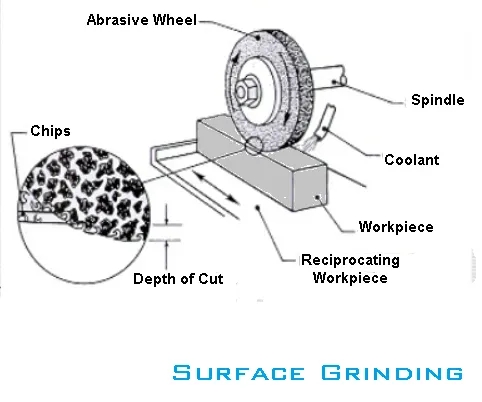
1. Surface Grinding
It involves grinding flat surfaces. Here the workpiece is fitted with a magnetic chuck attached to a work table of the grinder. Non-magnetic are held by vices or fixtures. A straight wheel is mounted on the horizontal spindle of the grinder.
Transverse grinding occurs as the table reciprocates longitudinally and feeds laterally after each stroke.
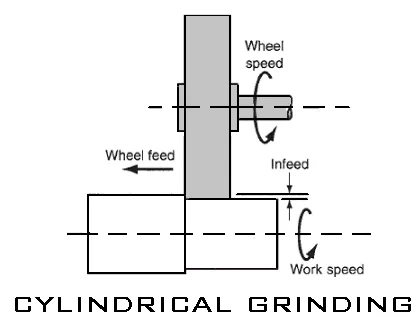
12. Cylindrical Grinding
In this, the operation is carried out on a cylindrical grinding machine which is made in two varieties “plain” and the “universal” type. The fundamental design is the same in both cases, but the universal machine can be adapted for internal grinding operation as well.
In cylindrical grinding machine operation, the work is mounted between two centres and is rotated. A grinding wheel is mounted on a spindle and revolves at a higher speed than the work. The depth of cut is very small, about 0.015 mm.
The work centres are mounted on a table which can transverse at various feeds so that the entire length of the work passes to and fro in front of the wheel.
When the entire work has passed in front of the wheel, the wheel advances forward by another 0.015mm at the end of the transverse and so the cycle of machining goes on until the desired diameter of the workpiece is reached. The result is a long cylinder of the perfectly circular profile with a very fine surface finish.
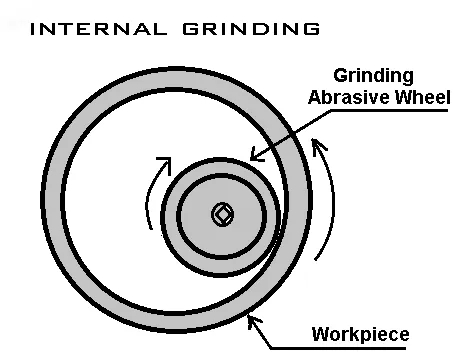
3. Internal Grinding
The Internal grinding operation means, grinding of internal holes or bores. Internal grinding is designed to grind the surface of bores, whether plain or tapered with the help of a small grinding wheel mounted on a long slender spindle which can enter in the bore.
It is capable of giving improved geometry of the hole as well as the surface finish. This operation is performed on specially designed internal grinding machines. For internal grinding, a softer wheel is generally preferred.
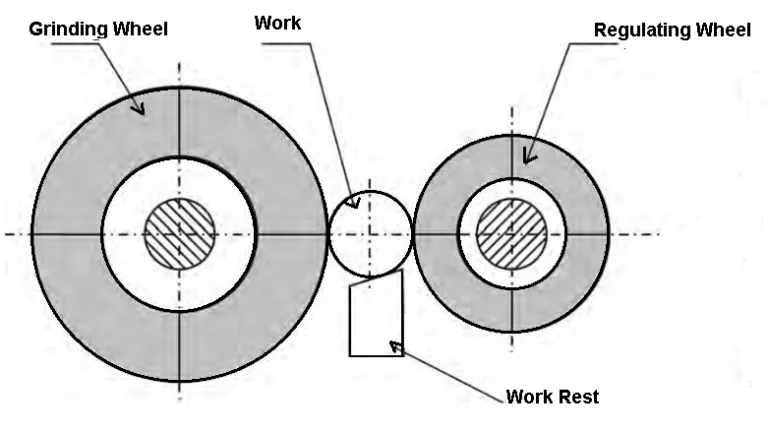
4. Centreless Grinding
It is a high production process for continuously grinding cylindrical surfaces in which the workpiece is supported not by centres or chucks, but by a blade. Parts with the diameter as small as 0.1mm can be ground by this method.
surface speed of the wheel is about 10000m/min using cubic boron nitride abrasive wheels. Parts such as roller bearing, piston pins, engine valves, and camshafts are made by centreless grinding.
The feed-in case of centreless grinding is given as,
S = ΠDN sinα
Where,
S = Feed
D = Diameter of regulating wheel
N = Speed in r.p.m
α = Angle of tilt.
Types of Centreless Grinding
The following are the three type of centreless grinding,
Through feed
Infeed
End feed
1. Through Feed
In this type of grinding the whole length of the bar or shaft is grinded which is placed on the work rest. The amount of material removed is 0.02 to 0.3mm.
2. Infeed
This type of grinding is used to grind parts that require multiple profiles to be grinded at the same time. The regulating wheel is moved backwards to place the workpiece on the work rest. This type of grinding is mainly used for formed grinding stops are provided at both the ends.
13. End Feed
In this type of grinding the tapered parts are grinded either the grinding wheel or the regulating wheel will have a tapered form.
Advantages of Centreless Grinding
A true floating condition exit so that little amount of material is removed.
There is no deflection of the work and small fragile workpiece can be grinded easily.
The process is continuous and used for production work.
No extra attachments such as centres, chucks are required.
The size of the work is easily controlled.
unskilled labour is required.
Disadvantages of Centreless Grinding
There is no concentricity when hollow workpieces are grinded.
The workpiece having multiple diameters cannot be grinded easily.
If you have any doubt or suggestion regarding “grinding machine” post please feel free to ask on comment section we’ll respond you.





















 Technical mechzone